
Most homeowners don't think about what's beneath their foundation until something goes wrong. If you've started looking into what is caisson drilling and when it's needed, there's a good chance you're dealing with a hillside property, failing foundation, or soil conditions that have a structural engineer pointing toward deep foundation work. At Unlimited Drilling & Foundations, caisson drilling has been our core specialty since 1993 — and across more than 1,000 completed projects in San Diego County, it's the solution we turn to most often for the region's toughest terrain.
Caisson Drilling Is the Deep Foundation Method Built for San Diego's Terrain
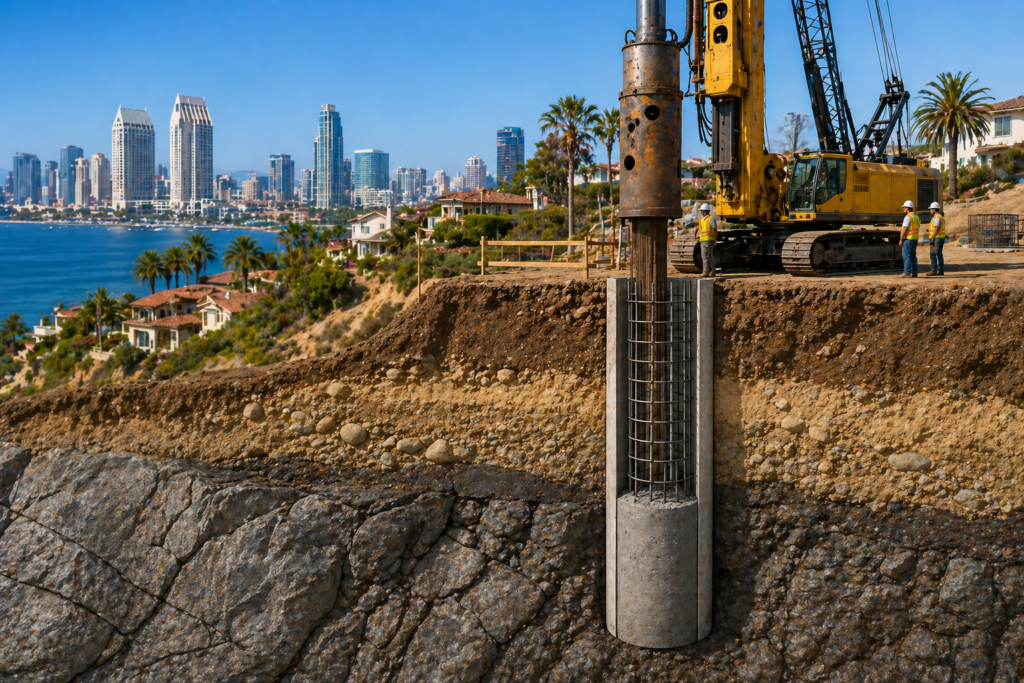
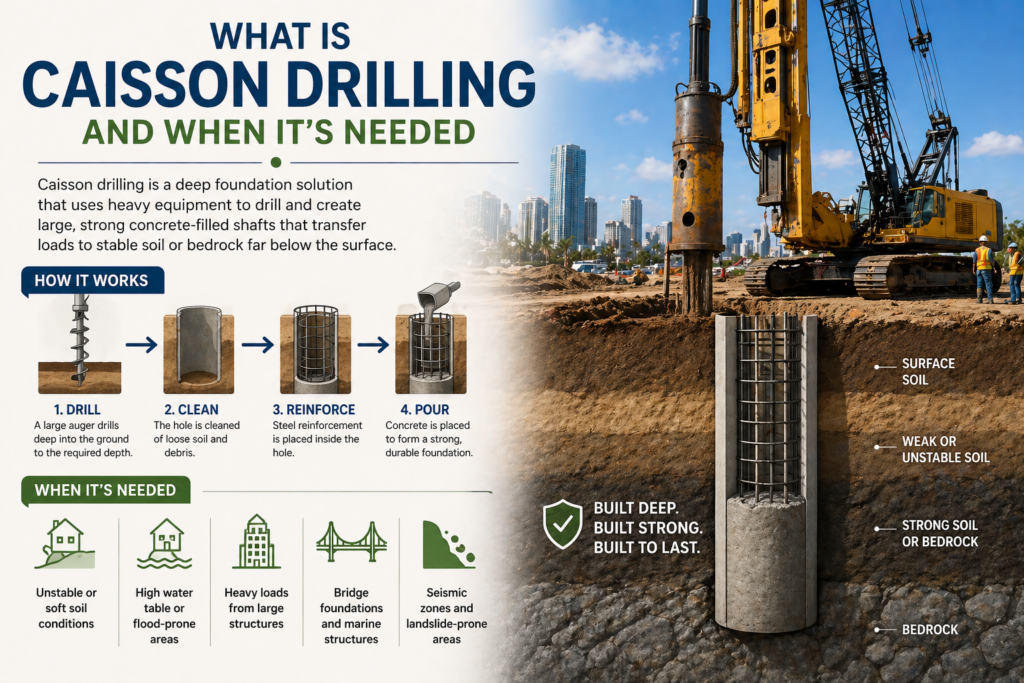
A caisson is a deep, cylindrical shaft drilled through weak or unstable surface soils and down to bedrock or competent bearing material far below grade. Once drilled, the shaft is reinforced with a steel rebar cage and filled with concrete, creating a structural column that transfers the load of a building or wall directly to ground that won't shift, settle, or slide.
Unlike shallow foundations — which rely on the strength of the soil immediately beneath a structure — caissons bypass surface-level problem soils entirely. This is precisely why they are the foundation method of choice across so much of San Diego County, where clay-heavy soils, steep hillsides, canyon lots, and seismic risk make shallow foundations insufficient for many residential and commercial structures.
How the Caisson Drilling Process Works, Step by Step
Understanding the process helps homeowners know what to expect when a contractor recommends caissons. Here's how a typical caisson installation unfolds on a San Diego project:
- Soils report and engineering — Before any drilling begins, a geotechnical soils report is completed to identify soil layers, bearing capacity, and the depth at which competent material is found. A structural engineer then uses this report to specify caisson diameter, depth, rebar configuration, and spacing.
- Site assessment and equipment selection — The drilling contractor evaluates site access, slope, and clearances to determine which rig is appropriate. On hillside or tight-access properties, specialized limited-access equipment is required.
- Drilling the shaft — A drill rig bores a cylindrical hole to the engineered depth — ranging from as shallow as a few feet to 50 feet or more, depending on where competent bearing soil or bedrock is found. Hole diameters typically range from 18 to 36 inches for residential projects.
- Rebar cage fabrication and placement — A steel reinforcing cage is tied to the specifications in the engineering plans, lowered into the drilled hole, and positioned at the correct depth before concrete is poured.
- Concrete pour — The hole is filled with concrete, encasing the rebar cage and forming the finished caisson shaft. The top of the caisson is then connected to a grade beam — the horizontal concrete beam that ties multiple caissons together and supports the structure above.
- Inspection and sign-off — Most structural caisson work in San Diego requires a city or county inspection before the grade beam is formed. The inspector verifies depth, rebar placement, and concrete specifications.
When Does a Property Actually Need Caisson Drilling?
Not every foundation problem calls for caissons. Here are the situations where they are the right — and often the only — appropriate solution:
You're Building or Repairing on a Hillside or Sloped Lot
This is the most common caisson application in San Diego. Hillside lots are subject to downslope soil movement, erosion, and the kind of lateral forces that shallow foundations simply cannot resist. Caissons drilled into bedrock anchor a structure against both vertical settlement and horizontal sliding — which is why they are the standard engineering solution for hillside homes throughout San Diego County, from La Jolla to El Cajon to Chula Vista.
Surface Soils Are Unstable, Expansive, or Filled
San Diego's geology includes significant areas of expansive clay soils that swell and shrink with seasonal moisture changes, as well as older residential lots with compacted fill placed decades ago to create a buildable pad. Both conditions create unreliable bearing conditions at shallow depths. Caissons drill past these problem layers to reach material that has the consistent strength to carry a structural load year after year.
Your Existing Foundation Is Settling or Failing
When an existing foundation has begun to move — evidenced by cracks in walls, sticking doors, sloping floors, or gaps at ceiling lines — caissons are often installed to arrest that movement and re-support the structure. The process involves drilling new caissons adjacent to or beneath the existing grade beam and connecting them to the foundation to transfer the load to stable bearing material. This is one of the most common repair applications we perform at Unlimited Drilling & Foundations.
You're Building a Retaining Wall on a Slope
Retaining walls on hillside properties carry significant lateral soil loads, and a wall footing that sits in shallow or unstable soil will eventually move. Caissons drilled beneath retaining wall footings provide the deep anchorage needed to keep walls stable under long-term soil pressure — especially in San Diego's canyon-adjacent neighborhoods where slope conditions are severe.
You're Installing a Pool or Accessory Structure on Unstable Ground
Swimming pools, detached garages, and large decks built on hillsides or over poor soils frequently require caisson foundations to prevent differential settlement. A pool that shifts or cracks is an expensive problem. Engineering the foundation correctly from the start with drilled caissons is almost always cheaper than repairing structural damage after the fact.
Limited-Access Caisson Drilling Solves San Diego's Biggest Job-Site Challenge
In a perfect world, every caisson job would have wide-open site access and a flat pad for equipment staging. In San Diego, that is rarely the case. Hillside homes sit on steep lots with narrow gates, low-clearance side yards, and no room to maneuver a standard drill rig. Canyon properties have restricted entry paths. Older urban neighborhoods were built with no thought given to future construction access.
This is where Unlimited Drilling & Foundations brings something most contractors cannot. Our fleet includes multiple rigs purpose-built for limited-access caisson drilling:
- Limited-access caisson rig — Requires only 36 inches of width. Drills 36-inch diameter holes to 50 feet in depth.
- Mini caisson drilling rig — Requires only 24 inches of width. Drills 18-inch diameter holes to 50 feet in depth.
- Mini crawler crane-mounted drill — Requires 36 inches of access with a 25-foot reach. Drills 24-inch diameter holes.
- Tripod drill — Fully portable and carry-in capable. Drills 6-inch diameter holes to 50 feet in depth for tight or confined spaces.
This range of equipment means we can reach properties that other contractors have to turn away. If a soils engineer and structural engineer have specified caissons for your home but you've been told the site is “too tight to drill,” contact us before you accept that answer.
How Long Do Caissons Last Once Installed?
Properly engineered and installed caissons are designed to last for the life of the structure they support. Because the reinforced concrete shaft is anchored into bedrock or dense bearing material, there is nothing below it to shift, compress, or erode. Unlike surface-dependent foundations, caissons don't degrade over time as near-surface soils dry, expand, or become saturated.
The longevity of a caisson system depends heavily on three factors: the accuracy of the soils report used to specify the depth, the quality of the rebar cage fabrication, and the integrity of the concrete pour. Cutting corners on any of these elements — which is exactly what happens when a low-bid contractor skips the engineering process — produces a caisson that may perform for years before quietly beginning to fail. Doing it correctly the first time, with proper engineering and inspection, is the only way to guarantee the long-term performance the system is designed to deliver.
Frequently Asked Questions About Caisson Drilling
What is the difference between a caisson and a pile?
A caisson (also called a drilled shaft or drilled pier) is installed by boring a hole and filling it with reinforced concrete in place. A pile is typically a pre-made structural element — steel, concrete, or wood — that is driven into the ground with impact or vibratory force. Caissons are more common in San Diego residential work because they can be precisely drilled to engineered depths in variable soil and rock conditions without the vibration or noise that driven piles create.
Do I need a permit for caisson drilling in San Diego?
Yes. Structural caisson work in San Diego County and the City of San Diego requires a building permit, a soils report, and engineer-stamped plans before work can begin. Reputable contractors will not drill structural caissons without completing this process. Any contractor willing to skip permitting on structural foundation work is a serious red flag.
How deep do caissons need to be drilled?
Depth is determined by the soils report and structural engineer, not by the contractor. The caisson must reach competent bearing material — stable soil or bedrock with sufficient capacity to carry the structural load specified by the engineer. In San Diego, this can range from 10 feet on some inland properties to 50 feet or more on hillsides where surface soils are deep and variable.
Can caissons be installed next to an existing structure?
Yes, and this is a common scenario on retrofit and repair projects. Caissons can be drilled immediately adjacent to existing foundations, retaining walls, or structures and connected via new or extended grade beams. Our limited-access equipment makes this possible even in tight urban or hillside conditions where standard rigs cannot operate safely.
How do I know if my home needs caissons or a different repair method?
The only reliable way to answer that question is through a professional site evaluation combined with a soils investigation. Warning signs — cracks in walls, sticking doors, movement in a retaining wall, or visible slope movement — are reasons to get an inspection, not a diagnosis by themselves. At Unlimited Drilling & Foundations, we offer no-obligation estimates that include an honest assessment of what type of repair is and isn't warranted for your specific site conditions.
Caisson drilling is specialized work that requires the right equipment, the right engineering, and a crew that has done it hundreds of times in your specific terrain. At Unlimited Drilling & Foundations, we've been doing exactly that throughout San Diego County since 1993. If you have a hillside, a failing foundation, or a project that requires deep foundation support, we'd like to take a look.